When is a group a team and when is a team a group?
We have been doing a lot of thinking, challenging and writing about this at the Group Coaching Academy, the conflation of groups and teams in the coaching profession often obscures the distinct purposes, dynamics, and competencies each requires. And visa versa through an endless time loop! The space this tends to impact most is within organisations. Perhaps a group is brought together for a project where they go on to form a team.
At the Group Coaching Academy, we use these definitions:
Group Coaching
Group coaching is when a coach works with several individuals at the same time, holding a space for them as they each pursue their own goals or development. The group members may not know each other or work together, but they share a common theme or interest. This may be within an organisation, e.g. Heads of Department from different teams or outside of an organisation e.g. a group of creative women returning to work after maternity leave. The skill of the coach lies in facilitating discussion and learning, encouraging peer support, and enabling members of the group to grow through shared experiences and collective wisdom.
Team Coaching
Team coaching is when a coach works with a team, a group of people who work together and share a common purpose or goal. This often takes place in the context of an organisation. The coach’s skills and focus enable the team to improve how they collaborate, communicate and perform together, focusing on both individual contributions and the team’s collective effectiveness. The aim is to maximise the team’s potential and achieve shared objectives, which are held overall by the organisation. The focus is on how the team thinks and behaves as a team going forwards. The skills and competencies required by the coach are in part understanding systems in organisations and hierarchies whilst encouraging equity.
Key Differences: Group Coaching vs. Team Coaching
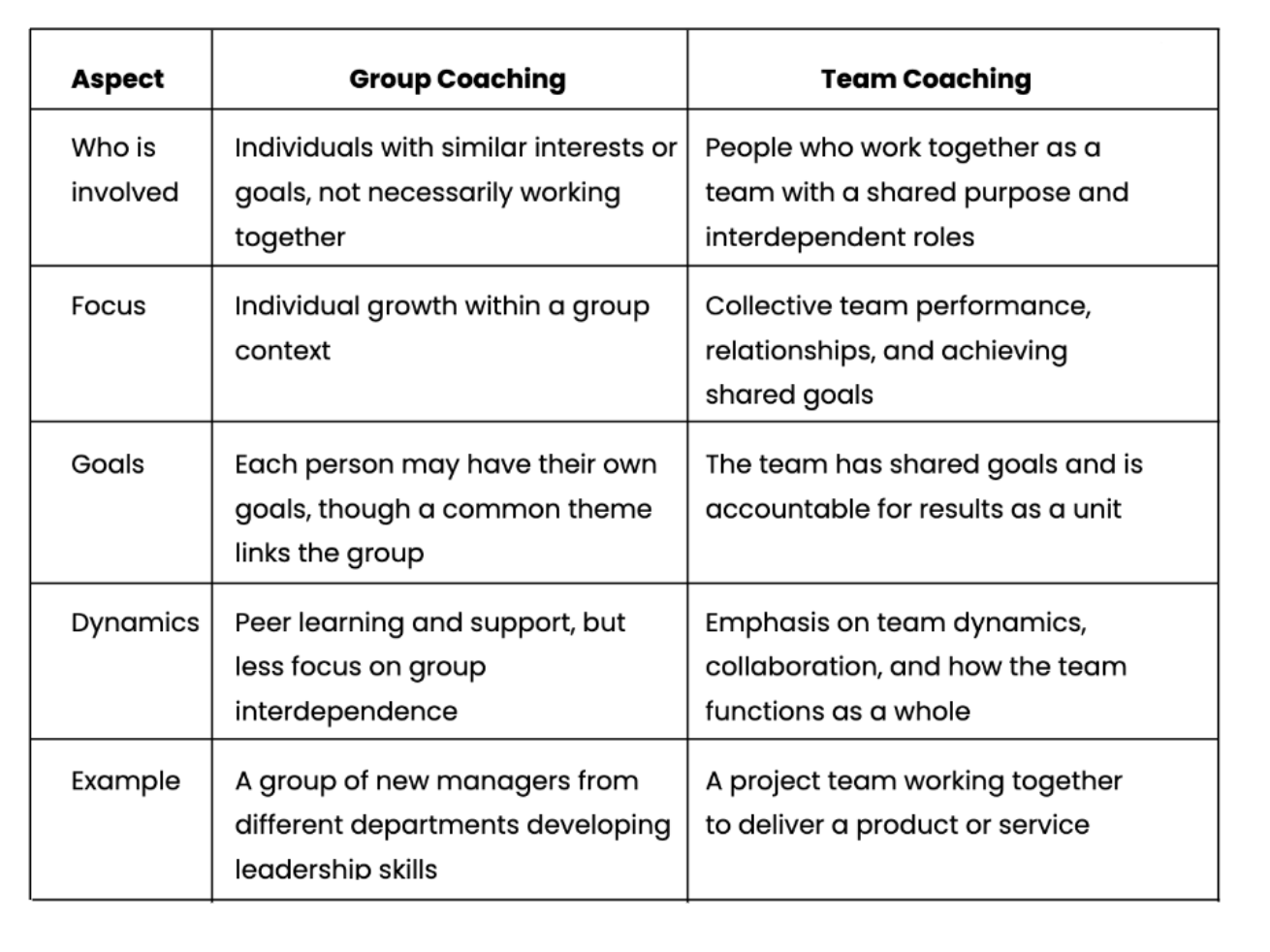
However, real life does not operate quite as clearly and smoothly as labels may suggest.
And while teams are bound by shared organisational goals and pre-existing relationships that shape their performance, groups gather around shared learning intentions or developmental themes. This difference matters, as coaches must adapt their stance, methods and possibly even ethics to suit the coaching context.
At The Group Coaching Academy, we see group coaching as a relationally rich, inclusive space, one that draws on diversity of experience rather than alignment of roles. The challenge lies in balancing individual development with the collective process, creating a psychologically safe environment where participants, often strangers to one another, can learn from the group’s collective intelligence.
And all this work we do with groups creates psychological safety, a space where participants can express themselves freely without fear of humiliation. It is deep work with a group of people coming together for the first time and crucial for developing ideas not yet fully formed, for innovation and exploration.
When coaching teams, it might be easy to assume that psychological safety pre-exists the coaching work and to skip more lightly through this phase. With the focus in team coaching being on aligning collective strategies and performance within an organisational system, the coach will be required to mediate conflict, navigate power hierarchies and facilitate systemic awareness.
Group coaching expands beyond organisational boundaries to invite multiple ways of knowing and being. It leans toward discovery, reflection, and shared wisdom. In this space, the coach’s role is catalytic rather than directive, holding the container for emergence rather than moving towards a defined outcome. The space is co-designed with the group. For the coach, the stance required embodies humility, curiosity, and trust in the group’s capacity to generate insight.
Looking ahead, the future of coaching will be increasingly shaped by the principles of group coaching, and it will be interesting to see how these might influence team coaching (the older of the siblings) for example: flattened hierarchies, collective sense-making, and innovation born from interconnectedness.
So when is a group a team and when is a team a group?
To answer this question, we need to understand the extent to which teams and groups are mutually exclusive. For us, the answer is no. You can use a label to help clarify expectations, but there can be an exciting grey area where there isn’t neat categorisation where we’re excited to do more exploring and thinking.
As both team and group coaching mature, we would like to see a move away from the idea of expert-led models toward a focus on creating communities of inquiry, where coaches and participants co-create understanding. The emphasis on ethical, context-specific training and reflexive practice will be vital as practitioners learn to hold complexity, difference, and shared humanity. When nurtured well, group coaching offers a powerful model for how learning and leadership can evolve in a more inclusive, participatory, and sustainable future.
Jana & Claire - The Group Coaching Academy